
 Русский
 Español
 عربي
عربي Tiếng Việt
 Türkçe
1. Operation of Pallet Jack Forks
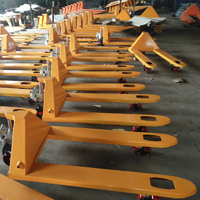
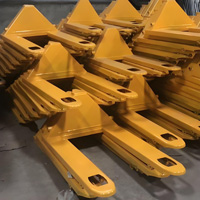
Pallet jack forks are mounted on manual or electric pallet jacks and are designed to slide under pallets for lifting and transporting loads. The forks are raised and lowered using a hydraulic pump mechanism operated by a handle. Once the forks are inserted into the pallet openings, the operator pumps the handle to lift the load slightly off the ground, allowing it to be moved smoothly. The forks distribute weight evenly to ensure stability during transit.
2. Types and Differences
-
Standard Forks: Typically made of solid steel, with fixed width and length, suitable for most uniform pallets.
-
Adjustable Forks: Allow width adjustment to accommodate different pallet sizes, enhancing versatility.
-
Extended Forks: Longer than standard forks, used for oversized or non-standard loads.
-
Tapered Forks: Feature a tapered tip for easier insertion into tight or damaged pallets.
-
Foldable Forks: Designed for compact storage and transport, ideal for multi-purpose equipment.
3. Applications
Pallet jack forks are widely used in warehouses, retail stores, manufacturing plants, distribution centers, and ports. They are essential for loading/unloading trucks, organizing inventory, and transporting goods within facilities. Specialized forks are also used in cold storage, food handling, and cleanroom environments.
4. Advantages
-
Efficiency: Enable quick and easy movement of palletized goods.
-
Safety: Reduce manual lifting and minimize workplace injuries.
-
Durability: Built to withstand heavy loads and frequent use.
-
Versatility: Compatible with various pallet types and sizes.
-
Cost-Effective: Low maintenance and long service life.
5. Materials
-
Carbon Steel: Most common, offering high strength and affordability.
-
Stainless Steel: Used in corrosive or hygienic environments (e.g., food industry).
-
Alloy Steel: Provides enhanced toughness and wear resistance.
-
Hardened Steel: Used in high-stress applications for extra durability.
6. Performance Factors
-
Load Capacity: Ranges from 2,000 to 5,000 kg depending on design and material.
-
Surface Finish: Smooth or coated surfaces reduce friction and pallet damage.
-
Wear Resistance: Affects longevity and maintenance frequency.
-
Environmental Resistance: Some forks are treated for moisture, chemical, or temperature resistance.